A LF L Ö H R
  • A L F L Ö H R
  • Painting
  • contact
  • ARCHIVE
  • books
PREVIEW VIDEO
Picture

​'ALTER EGO'
Scenic musical improvisation
 Figures: Alf Löhr
Concept: Ulrike Brand
Performers:
Sicilian Improvisers Orchestra
Ulrike Brand, Cello
 
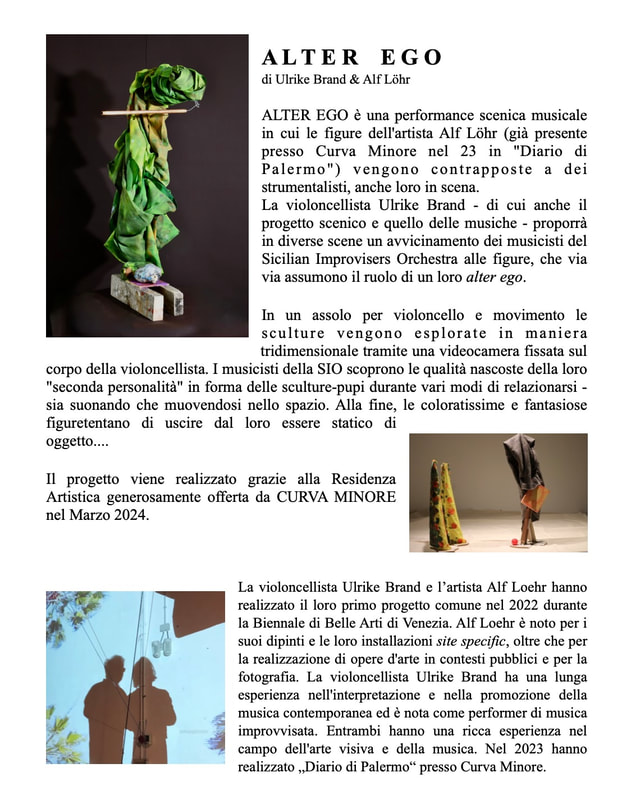
 Alf Löhr's figures for this performance of Ulrike Brand's musical piece for cello and improvising orchestra, have a deep sense of irony. Regardless of their individual character - they present futility to balance the highly skillful and internationally accomplished musicians in a humorous but also hauntingly serious way. Such are the tools of an inspiring collaboration. 
 
The futility arises from the similarity of the figures to human bodies and their deviation from them. A figure standing on the floor is about half the height of a standing person. The cloth objects are made from painted fabrics which result from the artist’s method of painting and from found objects. They are twisted into crooked shapes which sometimes look like hanging limply. Hints of heads: a tied-off bundle of fabric, a cloth sack with a huge pink patch, a green fabric tied to the side that suddenly resembles an animal. Two sack-like shells without any hint of heads, which nevertheless clearly suggest two beings in their twin-like appearance. Nevertheless, all the figures remain sculptures: their design never goes so far as to clearly define a human body.
 
Some figures can perform small movements with the help of wires or strings. However, these movements remain incomplete:  a tiny arm rises halfway and then falls back, the two sacks tremble slightly, the sack with the pink spot tries to pull itself up and then falls limply down next to the body. All attempted movements have an air of delusion and failure. But at the same time, they are strangely likable because they remind us of our childhood where we all have encountered characters that were familiar and spooky at the same time. 
 
In the scenic improvisation "Alter Ego", each of the characters is assigned a doppelganger between the musicians of the Sicilian Improvisers Orchestra. By improvising on their instruments, the musicians spin an invisible conversation with their respective alter egos. They translate their perception of the characters into sounds that emerge from the instruments in the very moment: a status report, so to speak, on the relationship between person and alter ego. The entire futility of the undersized existences with their vulnerable movements is transposed into sounds that dissolve in space. The instrumentalists communicate communicating through soft and gentle sounds.
 
But individual figures have sounds of their own: they emerge from their muteness and rattle with wooden slats or rattle with the tin cans that make up their bodies. The musicians react to the clattering and rattling figures with rejection. They stand up to show their sovereignty over the Pupi*. They walk around each other playing their instruments but then leave the stage - except for one: the cellist crosses the invisible border into the realm of alter egos. But the cello seems too loud, too beautiful with its varnish amidst the fabrics. So, she puts the cello aside and sits down on the floor next to an alter ego and begins to speak to him...
 
This play is in a language that is not spoken. It is about communication with the "other" and understanding silence. About the attempt to encourage musicians to reach their alter ego through sounds. About the appreciation of vulnerability, failure, and the appreciation of otherness. (A.L./U.B.)
 
 
* "Pupi" is the name given to the traditional, typically Sicilian marionettes.

  • A L F L Ö H R
  • Painting
  • contact
  • ARCHIVE
  • books